


Helwan University strives to be a leading educational and research institution in technology and the arts, and excels in education and sciences according to international quality standards
- Visits 1738193
A Global Environmental Innovation by Engineering Students of Matariya: Helwan University Represents Egypt in an International Competition with an Eco-Friendly Concrete Mix Made from Industrial Waste
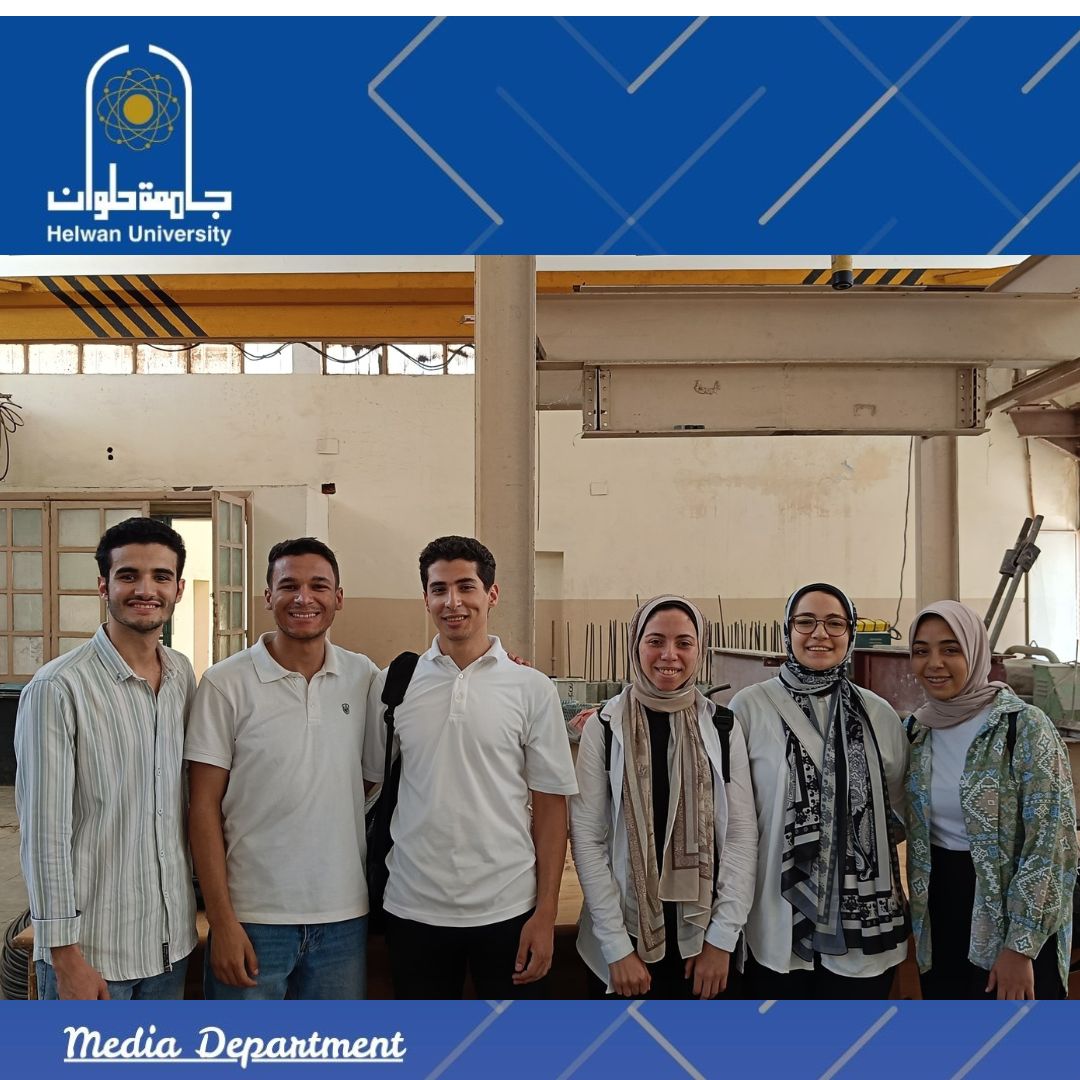
In a step that reflects Helwan University's deep commitment to supporting its outstanding students and nurturing promising minds, a student team from the Faculty of Engineering at Matariya participated in an international competition organized by the American Concrete Institute (ACI) in Michigan, USA. The team presented an advanced scientific project aligned with global environmental sustainability standards, showcasing the ability of young Egyptian minds to innovate and compete on an international level. This participation was under the patronage of Dr. El-Sayed Kandil, President of Helwan University, Dr. Amr Abdel Hady, Dean of the Faculty of Engineering at Matariya, and supervised by Dr. Noha Nabil, Vice Dean for Postgraduate Studies and Research.
The participation involved third-year civil engineering students competing in the Eco-Concrete 2025 competition, which required student teams to submit environmentally friendly concrete mixes by replacing a significant portion of cement with alternative materials derived from industrial waste—while maintaining structural strength and durability. As part of their preparation, the team underwent intensive practical training for over two months, including field visits to coal-fired power plants and cement and steel factories to collect samples and study the chemical and physical properties of industrial byproducts.
After a series of precise laboratory experiments conducted at the laboratories of the Faculty of Engineering in Matariya, the team successfully developed a new concrete mix in which 40% of cement was replaced with a combination of fly ash and iron blast furnace slag—both environmentally harmful industrial wastes—along with a small percentage of silica fumes. Test results showed that the new mix matched traditional concrete in short-term strength and outperformed it in long-term durability and resistance, particularly in humid and coastal environments, making it an ideal and sustainable alternative for infrastructure projects.
Dr. El-Sayed Kandil, President of Helwan University—who prioritizes supporting innovative students and believes that investing in young minds is the true path to a better future—affirmed that the achievement of Matariya’s engineering students is a real model of talented students. He emphasized that the university is strongly committed to fostering a culture of innovation across its faculties and providing all the necessary resources to transform scientific research from theoretical knowledge into practical applications that serve society and the environment, positioning Egypt competitively on the global higher education and research map.
Dr. Amr Abdel Hady, Dean of the Faculty of Engineering at Matariya, expressed great pride in what the students accomplished, noting that the project reflects their academic excellence and ability to tackle environmental challenges through smart and sustainable engineering solutions. He added that the faculty is keen on integrating students into international projects and providing an academic environment that promotes critical thinking, teamwork, and practical application of engineering curricula—a commitment clearly reflected in this remarkable achievement.
It’s worth mentioning that the project is led by student Ahmed Mokhtar, alongside a team of six students, and under the academic supervision of Dr. Mohamed Helmy, Dr. Marwa El-Naggar, Dr. Waleed Tawheed, and Dr. Awad El-Hashimi. The team presented a detailed study showing that widespread use of this sustainable concrete mix could save Egypt approximately 12 billion EGP annually by reducing cement production, while also lowering environmental pollution and promoting recycling culture. This aligns with the objectives of the Climate Conference, Egypt Vision 2030, and the political leadership’s directives toward achieving sustainable development.
The team extended its sincere thanks to the university and faculty administration for the extensive academic and logistical support and for granting access to laboratories and research facilities, which directly contributed to reaching this high level of performance and innovation.
Helwan University strives to be a leading educational and research institution in technology and the arts, and excels in education and sciences according to international quality standards